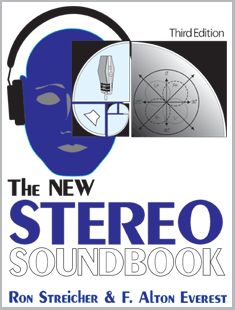
Review of: The New Stereo Soundbook
Authors: Ron Streicher and F. Alton Everest
Reviewed by: John Eargle
The second edition of The New Stereo Soundbook replaces the discontinued 1992 edition and is a welcome addition to literature easily understood by aspiring recordists and engineers. The book emphasizes "how-to" approaches to many recording problems but is by no means limited in terms of theoretical background.
The New Stereo Soundbook, third edition, is being marketed directly by Audio Engineering Associates, Pasadena, CA (www.ribbonmics.com) and is priced at $68.00 per copy, plus shipping and applicable California State Sales Tax.
The book begins with a short history of stereo, emphasizing the work of our founding fathers, Alan Blumlein and Harvey Fletcher. Then follows a basic discussion of how stereo information is conveyed through a combination of both delay and amplitude differences between the two stereo channels.
Chapter 3 relates the perception of stereo to the auditory realm, discussing some very important subjects, such as: masking, binaural unmasking, head-related transfer functions at the ears, effects of reflections on music and speech, and localization in the median plane.
Ultimately, what is recorded for commercial stereo represents not so much
theory, but an assessment of what sells and what produces a convincing sonic experience over a pair of loudspeakers in the home or in the automobile. Whose perspective is being presented here? What is the interplay among artist, producer, engineer, and record company? What are the commercial opportunities that are presented? These are discussed in Chapter 4.
Then follows a discussion of basic stereo techniques using only two microphones, including the creation of phantom images, the relation between
direct sound and reverberation, and an introduction to how a pair of loudspeakers can produce a spatial sound field extending well beyond the bounds of the two-loudspeaker array.
Subsequent chapters deal with binaural sound (a sub-set of stereo -- or is it the other way around?), coincident microphone techniques (including the often ignored mid-side technique), audibility and control of reflections in the recording environment, and spaced microphone techniques.
Pseudostereo, auditory spaciousness, pop recording techniques, and surround sound are covered, as is a practical assessment of listening and monitoring environment problems and solutions.
Throughout the book we see the interplay between Ron Streicher the knowledgeable recording engineer and Alton Everest the learned acoustician. Between them, they convey the essence of stereo recording practice as it has evolved in step with the fundamentals of psychological acoustics. Highly recommended.
John Eargle wrote this review for the AES Journal. It appeared in Volume 47, No. 1/2, 1999 January/February on Page 64.