BOOK REVIEW
“The New Stereo Soundbook”
Ron Streicher and F. Alton Everest
by RICHARD BURDEN
published in “Radio World” Magazine January 19, 2000
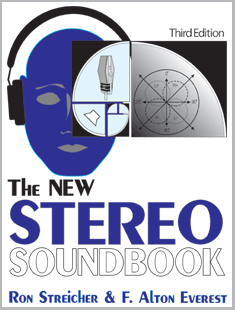
If you have even a slight interest on the subject of the stereophonic illusion, the second edition of “The New Stereo Soundbook” by Ron Streicher and F. Alton Everest is for you. A wealth of information in an easy-to-understand text is presented within its covers.
This is not the type of book that you can pull from your bookshelf and use as a handy guide or “how to do it” text to set up microphones for recording or remote broadcast. Rather, it provides the thought process to evaluate the environment in which the recording will be made and the tools with which you have to work.
While we may think that stereophonic reproduction is a 1950s and 1960s kind of thing, this book pays homage to the pioneers and the early efforts of stereophonics in the ’30s. Take time to read this. Much of this work is in vogue today.
Higher math is avoided in this book, which first appeared in 1991. Illustrations and a concise text present the fundamentals in a simple manner. The Table of Contents includes chapters on auditory basics such as “How
Stereophonic Information in Conveyed.”
Take time to read about “Stereo and the Auditory System.” This is an interesting and informative discussion that explains the auditory effects of time, frequency, and amplitude and their relationship to the stereophonic illusion.
The text presents the basic approaches of various microphone techniques and explains the relative advantages and disadvantages of each. Each of the various techniques has a chapter devoted its particular approach. Attention to these chapters will guide the reader in selecting the wisest approach to recording in the particular situation.
Reading the chapter on “Audibility of Reflections” is another must. Too often, the pickup is marred by inattention to the properties of the room, the microphone placement, and polar pattern of the microphones employed.
The topic of spaciousness, the techniques of Surround Sound, and multichannel 5.1 are all covered in the book. Included also, is a chapter on improving the listening environment.
The book concludes with an Appendix containing the British patent of Alan Blumlein. His vision of how to capture the stereophonic illusion and reproduce it is a cornerstone of the stereophonic disc recording and the
matrix employed in stereophonic broadcasting. His basic research appeared a quarter century before the reality of his early efforts was realized. This is interesting reading, especially when you relate his early work with the standards employed today.
Photos, diagrams, and a glossary of terms are included.
Before you embark on any recording project or remote broadcast, read the chapter on “Philosophical and Pragmatic Approaches to Stereo.” Don’t leave home without reading it. The thought process in evaluating the desired result before you embark on the project is worth the price of the book.
“The New Stereo Soundbook,” Second Edition, is available from Audio Engineering Associates in Pasadena, Calif. For information, call (800) 798-9127 or visit the Web site at http://www.stereosoundbook.com